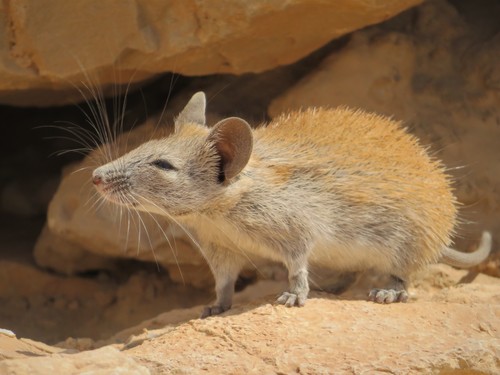
Golden Spiny Mouse
Acomys russatus
Conservation Status
Least ConcernMammalia · Rodentia · Muridae
About
The golden spiny mouse gets its name from the reddish-orange spiny fur that covers its body from head to tail. This coarse, inflexible fur is thought to protect it from predation. Aside from the golden fur that covers its head and upper parts, its flanks are yellow and its underside is pale. It has gray legs with pale feet and black soles. It is also described as having a small, but distinct white spot under each eye. It is often found in the wild missing a part or all of its tail because it is able to shed this as a defense mechanism. However, it is not known how this is done, how often it can occur, or under what conditions. It lives an average of three years in the wild. It is omnivorous and feeds on seeds, desert plants, snails, and insects. Living in desert regions, it is a xeric animal that obtains water from the plants that it eats and produces very concentrated urine in order to conserve water. A. russatus is naturally nocturnal, but adapts to being diurnal when it shares a habitat with A. cahirinus.
Fun Fact
This coarse, inflexible fur is thought to protect it from predation.
Quick Facts
Habitat
Found in the high summits of the mountains in southern Sinai where the temperature falls well below this threshold and there is often snow in the winter.
Diet
Feeds on seeds, desert plants, snails, and insects.
Lifespan
To be updated
Threats
- Habitat Change
- Human Disturbance