Blackbuck
Antilope cervicapra
Conservation Status
Least ConcernMammalia · Artiodactyla · Bovidae
About
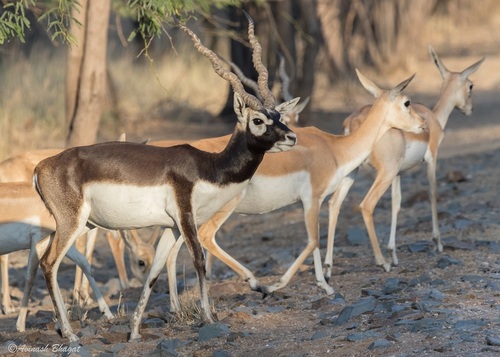
The blackbuck, also known as the Indian antelope, is a medium-sized antelope native to India and Nepal. It inhabits grassy plains and lightly forested areas with perennial water sources. It stands up to 74 to 84 cm high at the shoulder. Males weigh 20–57 kg (44–126 lb), with an average of 38 kg (84 lb). Females are lighter, weighing 20–33 kg (44–73 lb) or 27 kg (60 lb) on average. Males have 35–75 cm (14–30 in) long corkscrew horns, and females occasionally develop horns, as well. The white fur on the chin and around the eyes is in sharp contrast with the black stripes on the face. Both sexes' coats feature a two-tone colouration; in males, the majority of the body is dark brown to black, with white circles around the eyes, white ears and tail, and the belly, lower jaw, and inner legs also white. Females and juveniles are yellowish-fawn to tan and display the same white areas, only with more of a beige tone than the males. Females also feature a more pronounced horizontal white side-stripe, starting around the shoulder and ending at the rump. The blackbuck is the sole living member of the genus Antilope and was described by Carl Linnaeus in 1758. Two subspecies are recognized.
Fun Fact
It stands up to 74 to 84 cm (29 to 33 in) high at the shoulder.
Quick Facts
Habitat
Inhabits grassy plains and thinly forested areas where perennial water sources are available for its daily need to drink.
Diet
Herbivore
Lifespan
15 years
Threats
- Habitat Change
- Human Disturbance