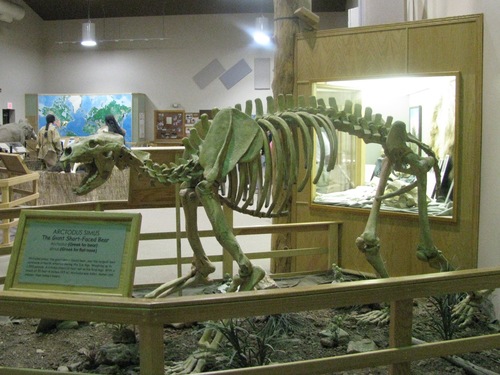
Giant Short-faced Bear
Arctodus simus
Conservation Status
Data DeficientMammalia · Carnivora · Ursidae
About
Arctodus is an extinct genus of short-faced bears that inhabited North America during the Pleistocene. The two recognized species are the lesser short-faced bear and the giant short-faced bear. Of these species, A. simus was larger, is known from more complete remains, and is considered one of the best-known members of North America's extinct Ice Age megafauna. A. pristinus was largely restricted to the Early Pleistocene of the eastern United States, whereas A. simus had a broader range, with most finds being from the Late Pleistocene of the United States, Mexico and Canada. A. simus evolved from A. pristinus, but both species likely overlapped in the Middle Pleistocene. Both species are relatively rare in the fossil record.
Fun Fact
Today considered to be an enormous omnivore, Arctodus simus is believed to be one of the largest known terrestrial carnivorans that has ever existed.
Quick Facts
Habitat
Found in the Potter Creek Cave, Shasta County, California, by J.
Diet
Carnivore
Lifespan
6 years
Threats
- Habitat Change
- Human Disturbance