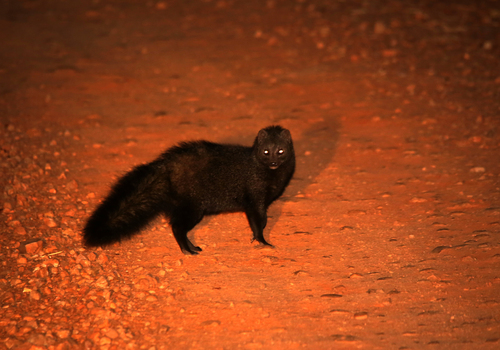
Bushy-tailed Mongoose
Bdeogale crassicauda
Conservation Status
Least ConcernMammalia · Carnivora · Herpestidae
About
The bushy-tailed mongoose is a sleek, medium-small carnivore of sub-Saharan Africa's eastern woodlands. Adults measure roughly 40–50 cm in body length with an additional 18–30 cm of tail, and weigh between 0.9 and 2 kg — about the size of a large squirrel. The fur is dark grizzled brown to near-black, dense and shaggy, and the tail — the animal's namesake feature — is thick and distinctly bushy, carried low as it moves. The face is rounded with short woolly ears and a pointed muzzle equipped with dentition adapted for crunching hard-bodied insects. This mongoose ranges across a wide band of eastern and central Africa, from the rocky hillsides south of Nairobi in Kenya through Tanzania, Zambia, Malawi, Mozambique, Zimbabwe, and into the southeastern Democratic Republic of Congo. It occupies a surprising variety of habitats: Brachystegia woodlands, moist savannas, river-fringe forest, coastal rainforest, boulder-strewn rocky hills, and montane forest up to nearly 1,900 metres in Tanzania's Udzungwa Mountains. One subspecies, Bdeogale crassicauda tenuis, is isolated on Zanzibar Island. At night, the bushy-tailed mongoose hunts alone, working methodically across the ground and scratching at soil with its strong curved claws to expose termites, beetle larvae, and other invertebrates. Termites are the dietary cornerstone, appearing in 86% of stomach samples studied, but the mongoose is an opportunist and will also take small lizards, frogs, rodents, scorpions, millipedes, and land snails. It is solitary outside of brief breeding associations and communicates largely through scent, using well-developed anal glands to mark territory. Breeding in Kenya is bimodal, peaking in March–May and again in October–December, with litters of 1–4 young. Despite being strictly nocturnal and secretive — essentially invisible to daytime observers — this species was recorded as the single most frequently photographed carnivore in a camera-trap survey across Tanzania's Udzungwa Mountains, outpacing genets, civets, and far more famous forest carnivores. It plays a meaningful ecological role as a predator of termites and beetles, and populations remain stable across most of its range.
Fun Fact
Despite being virtually invisible to humans, the bushy-tailed mongoose was the single most frequently photographed carnivore species in a systematic camera-trap survey across Tanzania's Udzungwa Mountains — outpacing genets, civets, and every other forest carnivore in the study area.
Quick Facts
Habitat
Miombo (Brachystegia) woodland, moist savanna, coastal rainforest, riverine forest, and rocky hill terrain across eastern and central Africa — from sea level to ~1,850 m in Tanzania's Udzungwa Mountains. Strongly associated with sheltered microhabitats (rock crevices, hollow logs, dense undergrowth) for daytime refugia. Range spans Kenya, Tanzania (including Zanzibar Island), Zambia, Malawi, Mozambique, Zimbabwe, and southeastern DRC.
Diet
Primarily insectivorous; termites dominate the diet (found in 86% of stomach samples), supplemented by beetles, lizards, frogs, small rodents, scorpions, millipedes, and land snails. Forages by scratching at soil with curved claws to expose buried insects and larvae.
Lifespan
~6–10 years (estimated; no confirmed long-term wild studies for this species)
Threats
- Habitat loss from agriculture and logging
- Coastal forest fragmentation (Kenya)
- Prey depletion from livestock overgrazing
- Roadkill