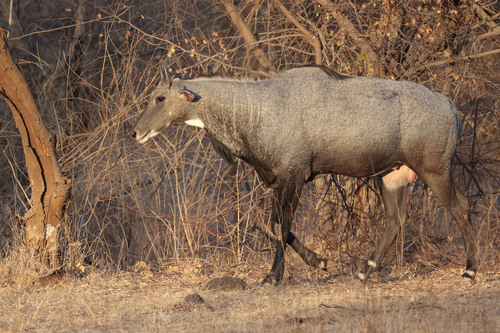
Nilgai
Boselaphus tragocamelus
Conservation Status
Least ConcernMammalia · Artiodactyla · Bovidae
About
The nilgai is the largest antelope of Asia, and is ubiquitous across the northern Indian subcontinent. It is the sole member of the genus Boselaphus, which was first scientifically described by Peter Simon Pallas in 1766. It is a sturdy, thin-legged antelope with a sloping back, a deep neck with a white patch on the throat, a short crest of hair along the neck terminating in a tuft, and white facial spots. A column of pendant, coarse hair hangs from the dewlap ridge below the white patch. It stands 100–150 cm (39–59 in) at the shoulder; males weigh 109–288 kg (240–635 lb), and the lighter females 100–213 kg (220–470 lb). A Sexual dimorphism is prominent; while females and juveniles are orange to tawny, adult males have a bluish-grey coat. Only males possess horns, 15–24 cm (5.9–9.4 in) long.
Fun Fact
Typically tame, the nilgai may appear timid and cautious if harassed or alarmed; it flees up to 300 m (980 ft), or even 700 m (2,300 ft), galloping away from the source of danger.
Quick Facts
Habitat
Grasslands and open woodlands
Diet
Herbivore
Lifespan
12-15 years
Threats
- Wildfire
- Habitat Fragmentation