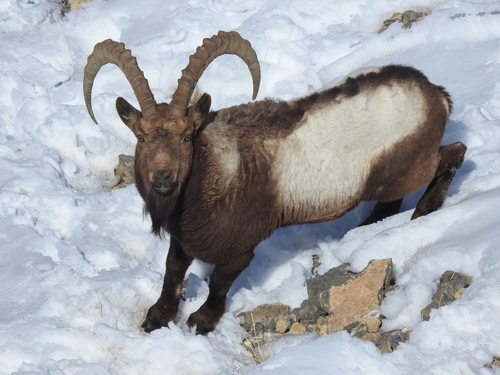
Siberian Ibex
Capra sibirica
Conservation Status
Near ThreatenedMammalia · Artiodactyla · Bovidae
About
The Siberian ibex, also known using regionalized names including Altai ibex, Asian ibex, Central Asian ibex, Gobi ibex, Himalayan ibex, Mongolian ibex, Tian Shan ibex, is a polytypic species of ibex, a wild relative of goats and sheep. It lives in Central Asia, and is, by far, the most widely distributed species in the genus Capra. In terms of population stability, Siberian ibex are currently ranked as Near Threatened. Low densities and overall decline; still, reliable data is minimal and difficult to come by, in addition to the animals' expansive natural range, so accurate observations are still scant. The Siberian ibex has, formerly, been treated as a subspecies of the Eurasian Alpine ibex, and whether or not it is a single species or a complex of distinct units that stand out as genetically-distinct is still not entirely clear. The Siberian ibex is the longest and heaviest member of the genus Capra, though its shoulder height is slightly surpassed by the markhor.
Fun Fact
The Siberian ibex is the longest and heaviest member of the genus Capra, though its shoulder height is slightly surpassed by the markhor.
Quick Facts
Habitat
Habitat consists of a mixture of high altitude steppe, alpine meadows, and regions of semidesert.
Diet
Eat more tall herbs, and the twigs and needles of trees such as aspen, spruce, juniper, and willow.
Lifespan
22 years (captivity)
Threats
- Habitat Change
- Hunting and Collection
- Climate Change