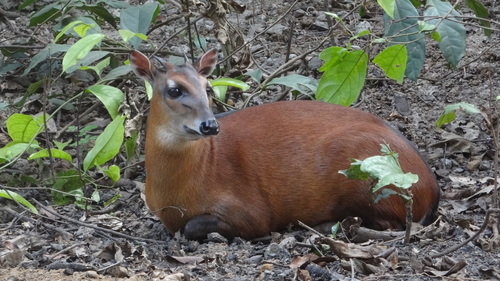
Bay Duiker
Cephalophus dorsalis
Conservation Status
Near ThreatenedMammalia · Artiodactyla · Bovidae
About
The bay duiker, also known as the black-striped duiker and the black-backed duiker, is a forest-dwelling duiker native to western and southern Africa. It was first described by British zoologist John Edward Gray in 1846. Two subspecies are identified. The bay duiker is reddish-brown and has a moderate size. Both sexes reach 44–49 cm (17–19 in) at the shoulder. The sexes do not vary considerably in their weights, either; the typical weight range for this duiker is 18–23 kg (40–51 lb). Both sexes have a pair of spiky horns, measuring 5–8 cm (2.0–3.1 in). A notable feature of this duiker is the well-pronounced solid stripe of black extending from the back of the head to the tail.
Fun Fact
Hence, sexual dimorphism in this species is not as remarkable as in other bovids, though females are often larger than males.
Quick Facts
Habitat
Occurred in the lowland forested areas (warm, moist rainforests) of Guinea.
Diet
Feeds on the large fruits of Irvingia species (wild mango), Detarium macrocarpum and the spherical fruits of Mammea africana.
Lifespan
18 years
Threats
- Habitat Change
- Hunting and Collection
- Climate Change