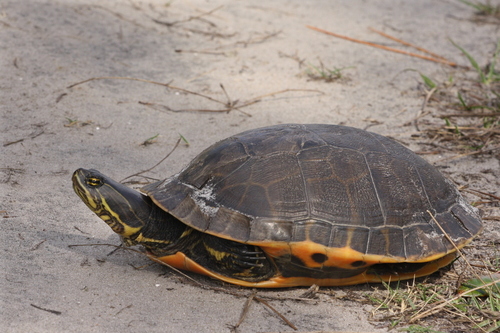
Chicken Turtle
Deirochelys reticularia
Conservation Status
Data DeficientReptilia · Emydidae
About
The chicken turtle is a turtle native to the southeastern United States. It is the only extant member of the genus Deirochelys and is a member of the freshwater marsh turtle family Emydidae. The chicken turtle's scientific name refers to its extremely long neck and distinctive net-like pattern on its upper shell. There are three regionally distinct subspecies, which are thought to have evolved when populations became separated during periods of glaciation. These subspecies can be distinguished by their appearance; the western chicken turtle displays dark markings along the seams of its plastron, while the plastron of the Florida subspecies is a bright yellow or orange color. Fossil records show that the chicken turtle has been present in the region for up to five million years.
Fun Fact
Like many reptiles, it spends much of the day basking in the sun to regulate its body temperature, but unlike most other aquatic turtles, it hibernates over the winter months except in the warmer, southernmost reaches of its range.
Quick Facts
Habitat
Inhabits moving water such as streams or rivers, but may sometimes colonize quieter rivulets or pools in the riparian zone.
Diet
Prey on crayfish, invertebrates, tadpoles, vegetation and carrion, including dead fish and other animals.
Lifespan
20–24 years
Threats
- Habitat Change
- Human Disturbance