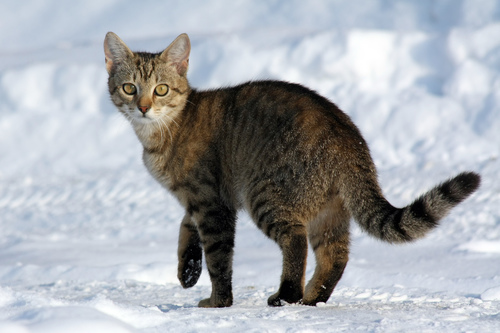
Domestic Cat
Felis catus
Conservation Status
Data DeficientMammalia · Carnivora · Felidae
About
The cat, also called domestic cat and house cat, is a small carnivorous mammal. It is an obligate carnivore, requiring a predominantly meat-based diet. Its retractable claws are adapted to killing small prey species such as mice and rats. It has a strong, flexible body, quick reflexes, and sharp teeth, and its night vision and sense of smell are well developed. It is a social species, but a solitary hunter and a crepuscular predator. Cat communication includes meowing, purring, trilling, hissing, growling, grunting, and body language. It can hear sounds too faint or too high in frequency for human ears, such as those made by small mammals. It secretes and perceives pheromones. Cat intelligence is evident in its ability to adapt, learn through observation, and solve problems. Female domestic cats can have kittens from spring to late autumn in temperate zones and throughout the year in equatorial regions, with litter sizes often ranging from two to five kittens.
Fun Fact
The cat skull is unusual among mammals in having very large eye sockets and a powerful specialized jaw.
Quick Facts
Habitat
Live in forests, grasslands, tundra, coastal areas, agricultural land, scrublands, urban areas, and wetlands.
Diet
Carnivore
Lifespan
To be updated
Threats
- Habitat Change
- Human Disturbance