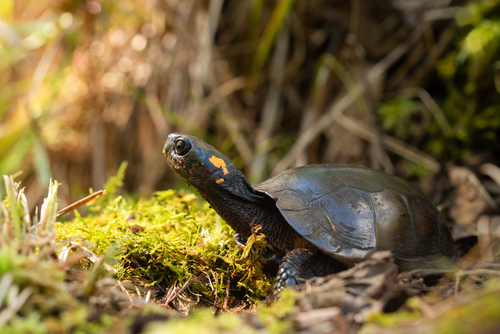
Bog Turtle
Glyptemys muhlenbergii
Conservation Status
Critically EndangeredReptilia · Emydidae
About
The bog turtle, also known commonly as Muhlenberg's turtle, is a critically endangered species of semiaquatic turtle in the family Emydidae. The species is native to the eastern United States. It was first scientifically described in 1801 after an 18th-century survey of Pennsylvania. The smallest North American turtle, it measures about 10 centimeters (4 in) in straight carapace length when fully grown. Although the bog turtle is similar in appearance to the painted turtle and the spotted turtle, its closest relative is actually the somewhat larger wood turtle. The bog turtle can be found from Vermont in the north, south to Georgia, and west to Pennsylvania. Diurnal and secretive, it spends most of its time buried in mud and – during the winter months – in hibernation. The bog turtle is omnivorous, feeding mainly on small invertebrates. The bog turtle is the state reptile of New Jersey.
Fun Fact
In its natural environment, it has a maximum lifespan of perhaps 50 years or more, and the average lifespan is 20–30 years.
Quick Facts
Habitat
Found in the bog turtle's habitat, as well as some shrubs and trees such as willows, red maples, and alders.
Diet
Eat aquatic plants (such as duckweed), seeds, berries, earthworms, snails, slugs, insects, other invertebrates, frogs, and other small vertebrates.
Lifespan
30 years (wild)
Threats
- Habitat Destruction
- Pollution
- Invasive Species
- Over-Collection
- Climate Change