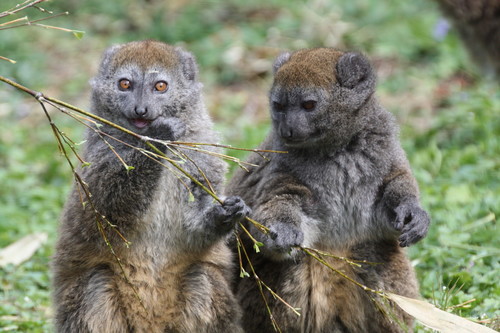
Alaotran Bamboo Lemur
Hapalemur alaotrensis
Conservation Status
Critically EndangeredMammalia · Primates · Lemuridae
About
The Alaotran bamboo lemur — known locally as the bandro — is a small, brownish-gray primate weighing about 1.1–1.6 kg with a head-body length of roughly 40 cm and a tail of similar length. Its large reddish-brown eyes help it see in the dim light of dense reed beds, and its long, slender fingers are perfectly shaped for gripping wet reed stalks. It navigates through the marsh by bending one stalk until it can reach the next, moving through the reeds like a slow-motion trapeze act above the water's surface. This species holds a unique title: it is the only primate on Earth that lives exclusively in a wetland ecosystem. Found nowhere else in the world except the papyrus and reed marshes ringing Lac Alaotra, the bandro has adapted to eat almost entirely papyrus and marsh reeds — a highly unusual dietary niche for a lemur. Unlike most primates with predictable day or night schedules, it is cathemeral — active at unpredictable times across the full 24-hour cycle, possibly to avoid midday heat. Family groups of 2–9 individuals, typically a monogamous pair with their offspring, share and defend territories within the marsh. Females are socially dominant, and all members use a communal latrine — consistently defecating at the same spot in their range. The bandro's population has collapsed from an estimated 11,000 individuals in the 1990s to roughly 2,500 today — a loss of more than 80% in under three decades. Every year, approximately 6% of its marsh habitat is burned or drained to make way for rice paddies. The species occupies one of the smallest ranges of any primate on Earth, and there is no backup population in another habitat — if the Lac Alaotra marshes disappear, the bandro goes with them.
Fun Fact
When reed beds catch fire — a common occurrence as farmers burn marshes for farmland — bandros swim to safety, with mothers carrying their infants on their backs across open water to escape the flames.
Quick Facts
Habitat
Papyrus and reed marshes of Lac Alaotra, northeastern Madagascar — the only wetland-specialist primate in the world. Restricted to ~20,000 ha of papyrus (Cyperus), reed (Phragmites), and sedge beds around Madagascar's largest lake at ~760 m elevation. Family groups hold territories of 1–8 ha within the marsh, spending virtually their entire lives perched above the water surface on reed stalks.
Diet
Papyrus and marsh reeds (leaves, stems, and young shoots)
Lifespan
~12 years (wild); up to 23 years (captivity)
Threats
- Marsh burning for rice cultivation
- Agricultural conversion of wetlands
- Hunting for bushmeat
- Water hyacinth invasion
- Siltation from upland deforestation