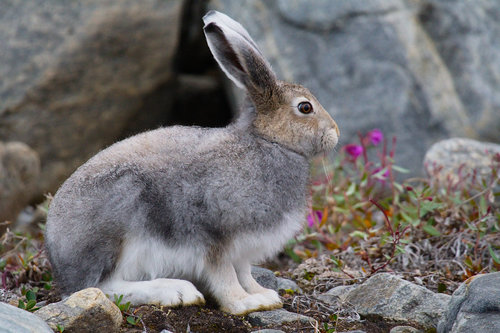
Arctic Hare
Lepus arcticus
Conservation Status
Least ConcernMammalia · Lagomorpha · Leporidae
About
The Arctic hare is a species of hare highly adapted to living in the Arctic tundra and other icy biomes. The Arctic hare survives with shortened ears and limbs, a small nose, fat that makes up close to 20% of its body, and a thick coat of fur. It usually digs holes in the ground or under the snow to keep warm and to sleep. Arctic hares look like rabbits but have shorter ears, are taller when standing, and, unlike rabbits, can thrive in extreme cold. They can travel together with many other hares, sometimes huddling with dozens or more, but are usually found alone, sometimes taking more than one partner. The Arctic hare can run up to 60 kilometres per hour (40 mph).
Fun Fact
Arctic hares can run at speeds up to 60 km/h (37 mph) and sometimes gather in groups of several hundred on the tundra — unusually social behavior for hares.
Quick Facts
Habitat
Arctic tundra
Diet
Herbivore
Lifespan
3-5 years
Threats
- Climate Change
- Contaminant Accumulation