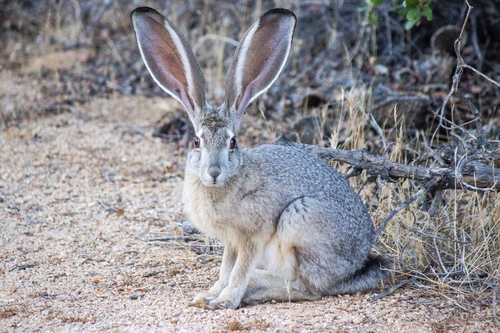
Black-tailed Jackrabbit
Lepus californicus
Conservation Status
Least ConcernMammalia · Lagomorpha · Leporidae
About
The black-tailed jackrabbit, also known as the American desert hare, is a common hare of the western United States and Mexico, where it is found at elevations from sea level up to 10,000 ft (3,000 m). Reaching a length around 2 ft (61 cm), and a weight from 3 to 6 lb, the black-tailed jackrabbit is one of the largest North American hares. Black-tailed jackrabbits occupy mixed shrub-grassland terrains. Their breeding depends on the location; it typically peaks in spring, but may continue all year round in warm climates. Young are born fully furred with eyes open; they are well camouflaged and are mobile within minutes of birth, thus females do not protect or even stay with the young except during nursing. The average litter size is around four, but may be as low as two and as high as seven in warm regions.
Fun Fact
Black-tailed jackrabbits use their enormous ears — up to 18 cm (7 in) — as radiators to dump body heat, with blood vessels that dilate in hot weather to release heat from their blood into the desert air.
Quick Facts
Habitat
Deserts and grasslands
Diet
Herbivore
Lifespan
5-6 years
Threats
- Agricultural Conversion
- Overgrazing