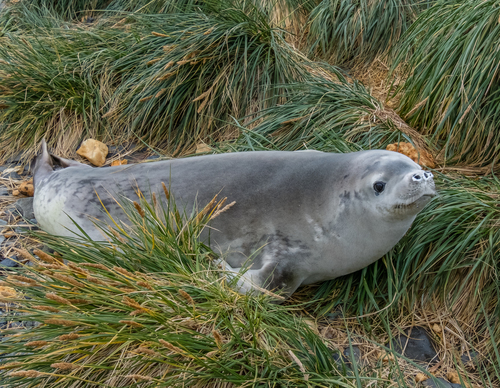
Crabeater Seal
Lobodon carcinophaga
Conservation Status
Least ConcernMammalia · Carnivora · Phocidae
About
The crabeater seal, also known as the krill-eater seal, is a true seal with a circumpolar distribution around the coast of Antarctica. They are the only member of the genus Lobodon. They are medium- to large-sized, relatively slender and pale-colored, found primarily on the free-floating pack ice that extends seasonally out from the Antarctic coast, which they use as a platform for resting, mating, social aggregation and accessing their prey. They are by far the most abundant seal species in the world. While population estimates are uncertain, there are at least 7 million and possibly as many as 75 million individuals. This success of this species is due to its specialized predation on the abundant Antarctic krill of the Southern Ocean, for which it has uniquely adapted, sieve-like tooth structure. Indeed, its scientific name, translated as "lobe-toothed (lobodon) crab eater (carcinophaga)", refers specifically to the finely lobed teeth adapted to filtering their small crustacean prey.
Fun Fact
Despite their name, crabeater seals don't eat crabs — they feed almost exclusively on Antarctic krill, using their uniquely lobed teeth as sieves to filter krill from seawater.
Quick Facts
Habitat
Antarctic pack ice
Diet
Carnivore
Lifespan
20-26 years
Threats
- Climate Change
- Shipping Routes