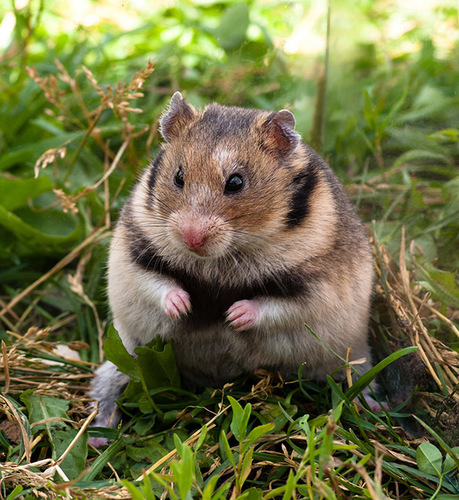
Brandt's hamster
Mesocricetus brandti
Conservation Status
Near ThreatenedMammalia · Rodentia · Cricetidae
About
The Turkish hamster, also referred to as Brandt's hamster, Azerbaijani hamster, or avurtlak, is a species of hamster native to Turkey, Azerbaijan and other surrounding nations. The Turkish hamster, first catalogued in 1878, is a fairly close relative of the Syrian or golden hamster, though far less is known about it, and it is rarely kept as a pet. The population of the Turkish hamster is said to be declining in the wild, yet this hamster is often used in laboratory testing. Turkish hamsters have lifespans of about two years and are solitary, nocturnal animals, which hibernate. They are reported to be more aggressive than other members of the family Cricetidae. They are tan and dark, sandy brown in color. Like all hamsters, the Turkish hamster has cheek pouches that allow it to carry large amounts of food at one time.
Fun Fact
Turkish hamster burrows are well-enough equipped for the hamsters to hibernate for four to 10 months (though sources do differ on this point), sometimes sleeping for 30 days at a time, though usually waking weekly for a day or two of activity.
Quick Facts
Habitat
Found in the wild throughout Europe and Asia and are considered to be extremely adaptable, living in scrublands, sand dunes, desert steppes and farmlands.
Diet
Eat insects on occasion and store roots and leaves in their burrows for hibernation.
Lifespan
To be updated
Threats
- Habitat Change
- Hunting and Collection
- Climate Change