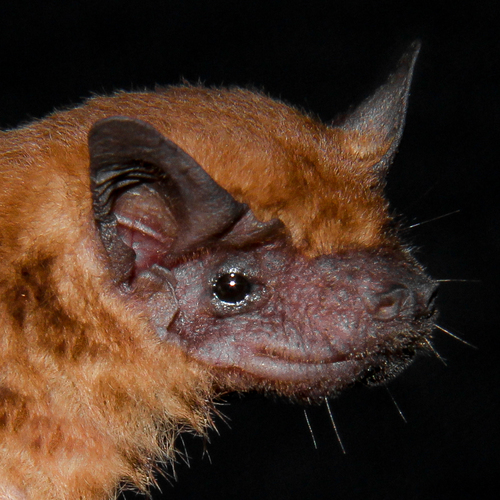
dwarf dog-faced bat
Molossops temminckii
Conservation Status
Least ConcernMammalia · Chiroptera · Molossidae
About
The dwarf dog-faced bat is a species of free-tailed bat from South America. It is found in Argentina, Bolivia, Brazil, Colombia, Ecuador, Guyana, Peru, Paraguay and Uruguay, typically at lower elevations. It is one of two species in the genus Molossops, the other being the rufous dog-faced bat. Three subspecies are often recognized, though mammalogist Judith Eger considers it monotypic with no subspecies. It is a small free-tailed bat, with a forearm length of 28.9–32.5 mm (1.14–1.28 in) and a weight of 5–8 g (0.18–0.28 oz); males are larger than females. It is brown, with paler belly fur and darker back fur. Its wings are unusual for a free-tailed bat, with exceptionally broad wingtips. Additionally, it has low wing loading, meaning that it has a large wing surface area relative to its body weight. Therefore, it flies more similarly to a vesper bat than to other species in its own family. As it forages at night for its insect prey, including moths, beetles, and others, it uses two kinds of frequency-modulated echolocation calls: one type is to navigate in open areas and to search for prey, while the other type is used for navigating in cluttered areas or while approaching a prey item.
Fun Fact
Its wings are unusual for a free-tailed bat, with exceptionally broad wingtips.
Quick Facts
Habitat
Found in a variety of biomes and ecoregions, including the Amazonian lowlands, Cerrado (tropical savanna), Caatinga (dry shrubland), Pantanal (wetlands), Atlantic Forest, Alto Paraná Atlantic forests, and Argentine Espinal.
Diet
Insectivore
Lifespan
To be updated
Threats
- Habitat Change
- Human Disturbance