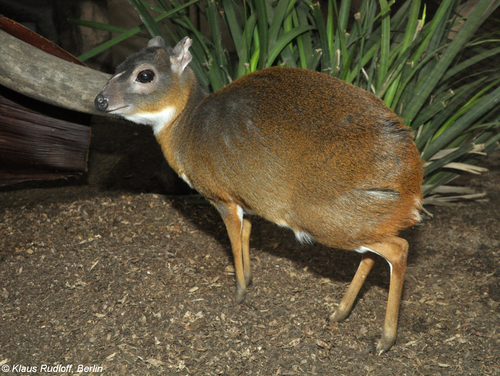
Royal Antelope
Neotragus pygmaeus
Conservation Status
Least ConcernMammalia · Artiodactyla · Bovidae
About
The royal antelope is a West African antelope recognized as the world's smallest. It was first described by Swedish zoologist Carl Linnaeus in 1758. It stands up to merely 25 cm (10 in) at the shoulder and weighs 2.5–3 kg (5.5–6.6 lb). A characteristic feature is the long and slender legs, with the hindlegs twice as long as the forelegs. Horns are possessed only by males; the short, smooth, spiky horns measure 2.5–3 cm (0.98–1.18 in) and bend backward. The soft coat is reddish to golden brown, in sharp contrast with the white ventral parts. In comparison to Bates's pygmy antelope, the royal antelope has a longer muzzle, broader lips, a smaller mouth and smaller cheek muscles.
Fun Fact
Typically nocturnal (active at night), the royal antelope exhibits remarkable alertness.
Quick Facts
Habitat
Found in the region north to the forested areas of western Africa, which is marked by the interface of forest and savannah habitats.
Diet
Herbivore
Lifespan
To be updated
Threats
- Habitat Change
- Human Disturbance