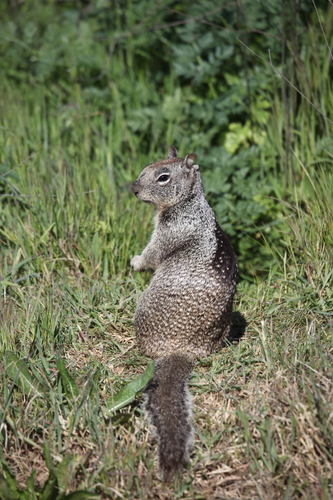
Douglas's Ground Squirrel
Otospermophilus douglasii
Conservation Status
Data DeficientMammalia · Rodentia · Sciuridae
About
Douglas ground squirrel is a rodent that has brown fur with small white spots on its head, back and flanks, with a dark patch between and behind its silvery shoulders, a lighter belly and a long, fluffy tail. It lives in colonies and makes extensive tunnels to sleep, shelter from danger, store food, and foster its newborns. It is an important prey species for snakes, birds of prey and mammalian predators. It eats seeds, and during the growing season, a variety of other parts of plants. It is regarded an agricultural pest, may cause damage to infrastructure due to its burrowing, and is considered a potential risk for human health since it harbors several infectious diseases. It can primarily be found in grasslands and open woodlands, from the coastline to the mountains, in central and southern Washington, Oregon, and northern California. In 2023, the International Union for Conservation of Nature had not yet determined the conservation assessment for this species. Douglas ground squirrel was initially described as a species, but later considered to be a subspecies of Otospermophilus beecheyi, the California ground squirrel. However, comparison of homologous DNA suggests Douglas ground squirrel should be considered as a separate species.
Fun Fact
Larger females will generally carry more embryos, up to 7, while smaller females carry fewer embryos, as few as 3.
Quick Facts
Habitat
To be updated
Diet
Feed on these squirrels during winter, there must be some level of surface activity during these months.
Lifespan
To be updated
Threats
- Habitat Change
- Human Disturbance