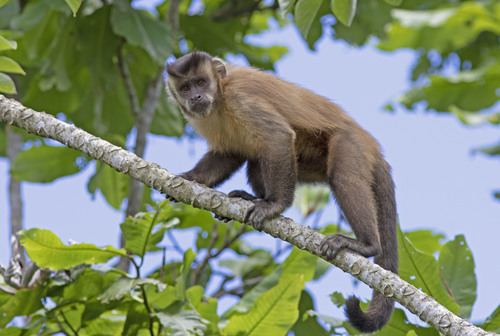
Hooded Capuchin
Sapajus cay
Conservation Status
VulnerableMammalia · Primates · Cebidae
About
Azaras's capuchin or hooded capuchin is a species of robust capuchin. It occurs in eastern Paraguay, southeastern Bolivia, northern Argentina, and Brazil, at Mato Grosso do Sul and Mato Grosso states, in Pantanal. Its habitat consists of subtropical, humid, semi-deciduous, gallery forests and forested regions of the Pantanals. Formerly, it was considered a subspecies of black-striped capuchin, according to Groves (2005) with the name Cebus libidinosus paraguayanus, but Silva Jr. (2001) considered it a separated species. They are considered as frugivores-insectivores which means that their diet mainly consists of a variety of fruits, seeds, arthropods, frogs, small mammals, etc.
Fun Fact
In captivity, individuals can live up to 50 years, while in the wild the average is around 30 years.
Quick Facts
Habitat
Range of habitats, including bush lands and savannas.
Diet
Eat larger objects than females (prey or plant matter); noticeably, only large males have been seen eating small vertebrates.
Lifespan
50 years (wild)
Threats
- Habitat Degradation
- Overexploitation
- Invasive Species
- Climate Change