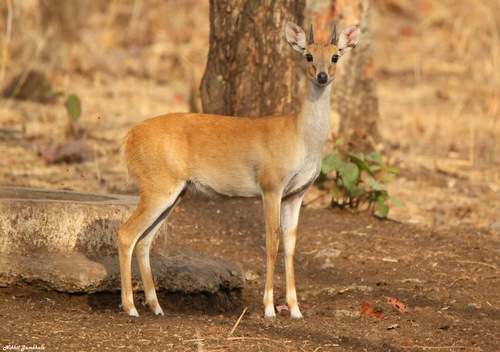
Four-horned Antelope
Tetracerus quadricornis
Conservation Status
Near ThreatenedMammalia · Artiodactyla · Bovidae
About
The four-horned antelope, also called chousingha, is a small bovid antelope native to central, South and Western India, along with a smaller population in Nepal. The sole member of the genus Tetracerus, the chousingha was first scientifically described in 1816 by French zoologist Henri Marie Ducrotay de Blainville. Three regional subspecies are currently recognised. The four-horned antelope has a yellowish-tan, sometimes reddish or goldenrod coat. It is slender with thin legs and a short tail. It stands nearly 55–64 cm (22–25 in) at the shoulder and weighs about 17–22 kg (37–49 lb). Its four horns are unique among antelopes and distinguish it from most other bovids. The longer pair of straight, spike-like horns is atop its head between the ears, while the other, shorter pair is on the forehead; its posterior horns are always longer than the anterior horns, which may even present as merely fur-covered "studs". While the posterior horns measure 8–12 cm (3.1–4.7 in), the anterior ones are usually 2–5 cm (0.79–1.97 in) long.
Fun Fact
Four-horned antelopes are the only bovids with four horns — the front pair are small bumps, while the rear pair are the main horns — and they are so shy that they were unknown to Western science until the 19th century.
Quick Facts
Habitat
Dry deciduous forests
Diet
Herbivore
Lifespan
10-12 years
Threats
- Deforestation
- Illegal Wildlife Trade
- Poaching