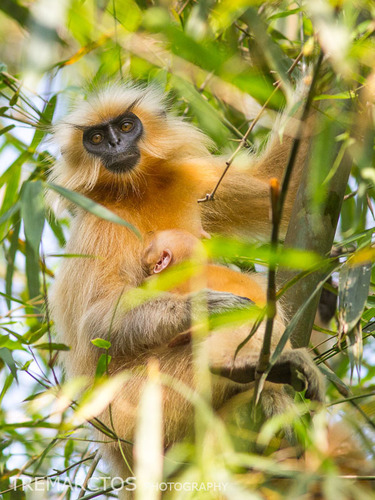
Gee's Golden Lutung
Trachypithecus geei
Conservation Status
EndangeredMammalia · Primates · Cercopithecidae
About
Gee's golden langur, also known as simply the golden langur, is an Old World monkey found in a small region of Western Assam, India and the neighboring foothills of the Black Mountains of Bhutan. Long considered sacred by many Himalayan people, the golden langur was first brought to the attention of the Western world by the naturalist Edward Pritchard Gee in the 1950s. Adult males have a cream to golden coat with darker flanks while the females and juveniles are lighter. The golden langur has a black face and a long tail up to 100 cm (39 in) in length. It lives in high trees and has a herbivorous diet of fruits, leaves, seeds, buds, and flowers. The average group size is eight individuals, with a ratio of several females to each adult male. It is one of the most endangered primate species of India and Bhutan.
Fun Fact
The golden langur has a black face and a long tail up to 100 cm (39 in) in length.
Quick Facts
Habitat
Found in an area of approximately 30,000 square kilometres (12,000 sq mi), much of which is unsuitable habitat, bounded on the south by the Brahmaputra River, on the east by the Manas River, on the west by the Sankosh River, in Assam, India, and on the north by the Black Mountains of Bhutan.
Diet
Diet of fruits, leaves, seeds, buds, and flowers.
Lifespan
To be updated
Threats
- Habitat Loss
- Poaching and Hunting
- Human-Wildlife Conflict
- Disease