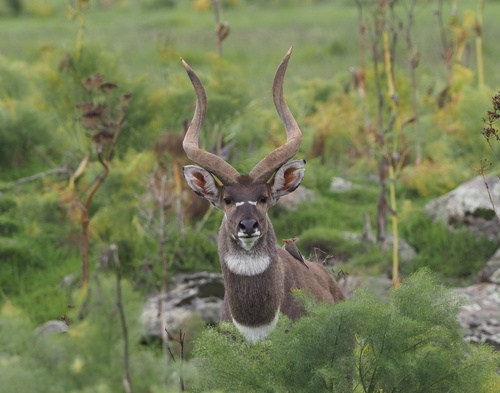
Mountain Nyala
Tragelaphus buxtoni
Conservation Status
EndangeredMammalia · Artiodactyla · Bovidae
About
The mountain nyala or balbok, is a large antelope found in high altitude woodlands in a small part of central Ethiopia. It is a monotypic species first described by English naturalist Richard Lydekker in 1910. The males are typically 120–135 cm (47–53 in) tall while females stand 90–100 cm (35–39 in) at the shoulder. Males weigh 180–300 kg (400–660 lb) and females weigh 150–200 kg (330–440 lb). The coat is grey to brown, marked with two to five poorly defined white strips extending from the back to the underside, and a row of six to ten white spots. White markings are present on the face, throat and legs as well. Males have a short dark erect crest, about 10 cm (3.9 in) high, running along the middle of the back. Only males possess horns.
Fun Fact
Bachelor herds are formed by non-dominant adult bulls and young males, consisting of up to 13 individuals.
Quick Facts
Habitat
Found in high altitude woodlands in a small part of central Ethiopia.
Diet
Feeds on low-height herbs, bushes, shrubs and general foliage.
Lifespan
20 years
Threats
- Habitat Loss
- Poaching and Hunting
- Human-Wildlife Conflict
- Disease