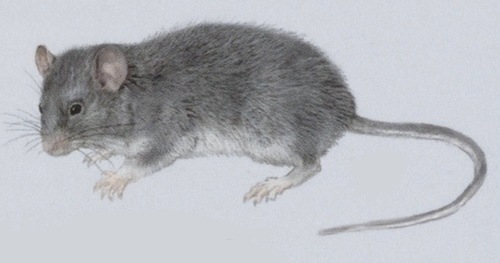
Northern Voalavo
Voalavo gymnocaudus
Conservation Status
Least ConcernMammalia · Rodentia · Nesomyidae
About
The northern voalavo, also known as the naked-tailed voalavo or simply the voalavo, is a rodent in the family Nesomyidae found in the Northern Highlands of Madagascar. Discovered in 1994 and formally described in 1998, it is the type species of the genus Voalavo; its closest relative is the eastern voalavo of the Central Highlands. DNA sequencing suggests that it may be more closely related to Grandidier's tufted-tailed rat than to other species of the closely related genus Eliurus. The northern voalavo is found at 1,250 to 1,950 m above sea level in montane wet and dry forests in the Marojejy and Anjanaharibe-Sud massifs. Nocturnal and solitary, it lives mainly on the ground, but it can climb and probably eats plant matter. Despite having a small range, the species is classified as being of least concern because it lacks obvious threats and much of its range is within protected areas.
Fun Fact
DNA sequencing suggests that it may be more closely related to Grandidier's tufted-tailed rat than to other species of the closely related genus Eliurus.
Quick Facts
Habitat
Found in wet mountain forest at 1,950 m (6,400 ft), where it occurred with the indigenous rodents Major's tufted-tailed rat and island mouse as well as the introduced black rat (Rattus rattus), and in drier forest at about 1,300 m (4,300 ft), where it may live alongside other species of Eliurus and Voalavoanala.
Diet
Eats plant matter.
Lifespan
To be updated
Threats
- Habitat Change
- Human Disturbance