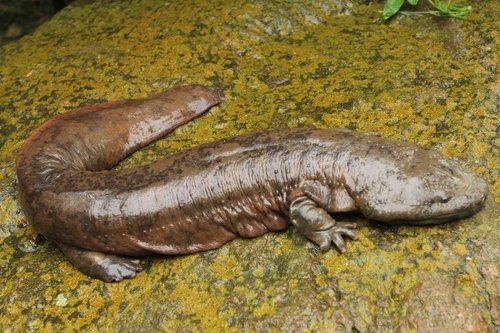
Chinese Giant Salamander
Andrias davidianus
Conservation Status
Critically EndangeredAmphibia · Caudata · Cryptobranchidae
About
The Chinese giant salamander is one of the largest salamanders and one of the largest amphibians in the world. It is fully aquatic, and is endemic to rocky mountain streams and lakes in the Yangtze river basin of central China. It has also been introduced to Kyoto Prefecture in Japan, and possibly to Taiwan. It is considered critically endangered in the wild due to habitat loss, pollution, and overcollection, as it is considered a delicacy and used in traditional Chinese medicine. On farms in central China, it is extensively farmed and sometimes bred, although many of the salamanders on the farms are caught in the wild. It has been listed as one of the top-10 "focal species" in 2008 by the Evolutionarily Distinct and Globally Endangered project.
Fun Fact
The Chinese giant salamander is the world's largest amphibian, reaching up to 6 feet long, and has been dubbed a 'living fossil' unchanged for 170 million years.
Quick Facts
Habitat
Range spans the area from Qinghai east to Jiangsu and south to Sichuan, Guangxi, and Guangdong; notably in the basins of the Yangtze, Yellow, and Pearl Rivers.
Diet
Prey on land with an asymmetrical bite, in such a way that the force created by their jaws will be maximized in the anterior region where their prey is located.
Lifespan
60 years (captivity)
Threats
- Commercial Harvest for Luxury Food
- Aquaculture Farm Escapees and Disease
- Habitat Degradation and Dam Construction