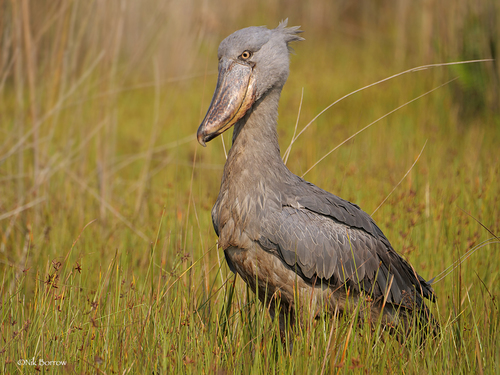
Shoebill
Balaeniceps rex
Conservation Status
VulnerableAves · Pelecaniformes · Balaenicipitidae
About
The shoebill, also known as the whale-headed stork, whalebill, and shoe-billed stork, is a large long-legged wading bird. Its name comes from its enormous, shoe-shaped bill. It has a somewhat stork-like overall form and was previously classified as a stork in the order Ciconiiformes, but genetic evidence places it with pelicans and herons in the Pelecaniformes. Adults are mainly grey, while juveniles are browner. It lives in tropical East Africa in large swamps from South Sudan to Zambia.
Fun Fact
The Shoebill's enormous clog-shaped bill has a razor-sharp hook, and it decapitates prey like lungfish and baby crocodiles before swallowing them whole.
Quick Facts
Habitat
Distributed in freshwater swamps of central tropical Africa, from southern Sudan and South Sudan through parts of eastern Congo, Rwanda, Uganda, western Tanzania, and northern Zambia.
Diet
Prey species have reportedly included marbled lungfish (Protopterus aethiopicus), African lungfish (Protopterus annectens), and Senegal bichir (Polypterus senegalus), various Tilapia species and catfish, the latter mainly in the genus Clarias.
Lifespan
To be updated
Threats
- Habitat Change
- Human Disturbance