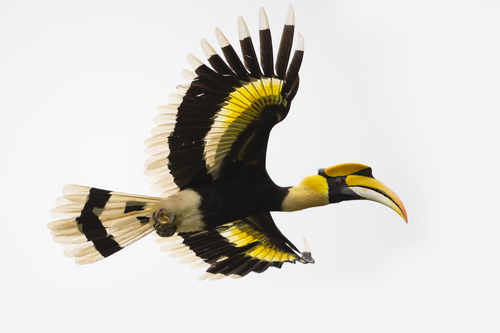
Great Hornbill
Buceros bicornis
Conservation Status
VulnerableAves · Bucerotiformes · Bucerotidae
About
The great hornbill, also known as the concave-casqued hornbill, great Indian hornbill or great pied hornbill, is one of the larger members of the hornbill family. It occurs in the Indian subcontinent and Southeast Asia. It is predominantly frugivorous, but also preys on small mammals, reptiles, and birds. It has been listed as Vulnerable on the IUCN Red List since 2018. It is known to have lived for nearly 50 years in captivity. Due to its large size and colour, and importance in many tribal cultures and rituals, the Government of Kerala declared it as the official Kerala state bird. It is also the state bird of Arunachal Pradesh.
Fun Fact
The female Great Hornbill seals herself inside a tree hollow with mud, leaving only a slit through which the male feeds her for the entire nesting period.
Quick Facts
Habitat
Native to the forests of India, Bhutan, Nepal, Mainland Southeast Asia and Sumatra.
Diet
Preys on small mammals, reptiles, and birds.
Lifespan
50 years (captivity)
Threats
- Habitat Change
- Human Disturbance