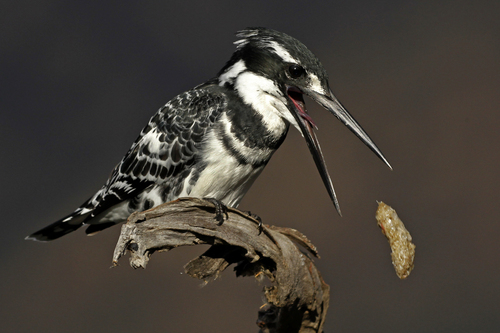
Pied Kingfisher
Ceryle rudis
Conservation Status
Least ConcernAves · Coraciiformes · Alcedinidae
About
The pied kingfisher is a species of water kingfisher widely distributed across Africa and Asia. Originally described by Carl Linnaeus in 1758, it has five recognised subspecies, and is the only member of the genus Ceryle. Its black and white plumage and crest, as well as its habit of hovering over clear lakes and rivers before diving for fish, make it distinctive. Males have a double band across the breast, while females have a single broken breast band. They are usually found in pairs or small family groups. When perched, they often bob their head and flick up their tail.
Fun Fact
Pied Kingfishers are unique among kingfishers in hovering over water before diving, and are the only large kingfisher capable of sustained hovering.
Quick Facts
Habitat
Distributed mainly on the plains and is replaced in the higher hills of the Himalayas by the crested kingfisher (Megaceryle lugubris).
Diet
Feeds mainly on fish, although it will take crustaceans and large aquatic insects such as dragonfly larvae.
Lifespan
To be updated
Threats
- Habitat Change
- Human Disturbance