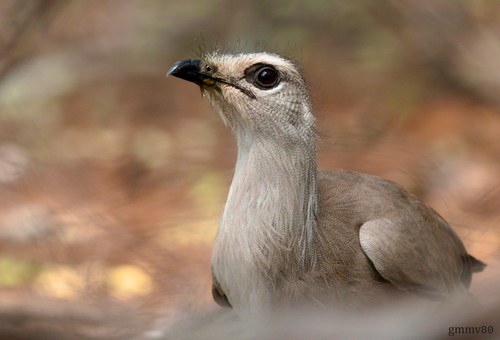
Black-legged Seriema
Chunga burmeisteri
Conservation Status
Least ConcernAves · Cariamiformes · Cariamidae
About
The black-legged seriema is one of two living species of seriemas in the family Cariamidae. It is found from southeastern Bolivia and northern Paraguay south into north-central Argentina. It is a large, mostly grey bird with a long neck, a long tail, and long, slender black legs. Its belly, vent and thighs are yellowish-white. The sexes look similar, as do immature birds, though the latter are more patterned on head, neck and back. First described for science by Gustav Hartlaub in 1860, it is monotypic, with no subspecies. Like its red-legged cousin, it is an omnivore. It seldom flies, instead pursuing prey and eluding danger on foot. Its loud calls, said to sound like kookaburras, turkeys or yelping dogs, are often given in duet. Little is known about its breeding ecology. It is known to breed in November and December, building a platform nest of sticks and laying two white eggs, which are sometimes marked with a few brownish or purple spots. The International Union for Conservation of Nature rates the species as one of least concern, due to its large range and apparently stable numbers.
Fun Fact
This makes it one of the largest ground-dwelling birds in the Neotropics; only the red-legged seriema and the rheas are larger.
Quick Facts
Habitat
To be updated
Diet
Omnivore
Lifespan
To be updated
Threats
- Habitat Change
- Human Disturbance