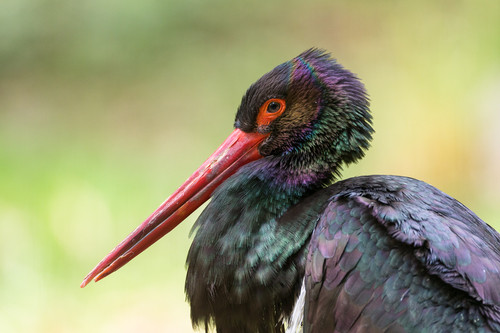
Black Stork
Ciconia nigra
Conservation Status
Least ConcernAves · Ciconiiformes · Ciconiidae
About
The black stork is a large bird in the stork family Ciconiidae. It was first described by Carl Linnaeus in the 10th edition of his Systema Naturae. Measuring on average 95 to 100 cm from beak tip to end of tail with a 145-to-155 cm (57-to-61 in) wingspan, the adult black stork has mainly black plumage, with white underparts, long red legs and a long pointed red beak. A widespread but uncommon species, it breeds in scattered locations across Europe, and east across the Palearctic to the Pacific Ocean. It is a long-distance migrant, with European populations wintering in tropical Sub-Saharan Africa, and Asian populations in the Indian subcontinent. When migrating between Europe and Africa, it avoids crossing broad expanses of the Mediterranean Sea and detours via the Levant in the east, the Strait of Sicily in the center, or the Strait of Gibraltar in the west. An isolated non-migratory population lives in Southern Africa.
Fun Fact
East of the Ural Mountains, the black stork is patchily found in forested and mountainous areas up to 60°‒63° N across Siberia to the Pacific Ocean.
Quick Facts
Habitat
Found in shallow water in rivers or lakes, or swamps, but is occasionally encountered on dry land.
Diet
Eats fish, including small cyprinids, pikes, roaches, eels, budds, perches, burbots, sticklebacks and muddy loaches (Misgurnus and Cobitis).
Lifespan
10 years
Threats
- Habitat Change
- Human Disturbance