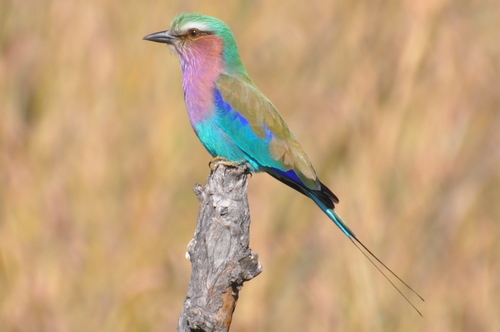
Lilac-breasted Roller
Coracias caudatus
Conservation Status
Least ConcernAves · Coraciiformes · Coraciidae
About
The lilac-breasted roller is an African bird of the roller family, Coraciidae. It is widely distributed in Southern and Eastern Africa, and is a vagrant to the southern Arabian Peninsula. It prefers open woodland and savanna, and it is for the most part absent from treeless places. Usually found alone or in pairs, it perches at the tops of trees, poles or other high vantage points from where it can spot insects, amphibians and small birds moving about on the ground. Nesting takes place in a natural hole in a tree where a clutch of 2–4 eggs are laid, and incubated by both parents, who are extremely aggressive in defence of their nest, taking on raptors and other birds. During the breeding season the male will rise to a fair height, descending in swoops and dives, while uttering harsh, discordant cries. The sexes do not differ in coloration, and juveniles lack the long tail streamers of adults. This species is unofficially considered the national bird of Kenya. Alternative names for the lilac-breasted roller include the fork-tailed roller, lilac-throated roller, Mosilikatze's roller, and troupand.
Fun Fact
Juveniles, immatures and adults have the largest alula feather dark blue, but the primary coverts and rest of the alula azure.
Quick Facts
Habitat
Occur commonly in Namibia (excluding the Namib Desert), Botswana, Zimbabwe, and northeastern South Africa.
Diet
Feed mainly on terrestrial prey, lilac-breasted rollers will perch to scout from a higher vantage point (including from atop of large herbivorous mammals) before swooping in and grabbing prey with their beaks.
Lifespan
To be updated
Threats
- Habitat Change
- Human Disturbance