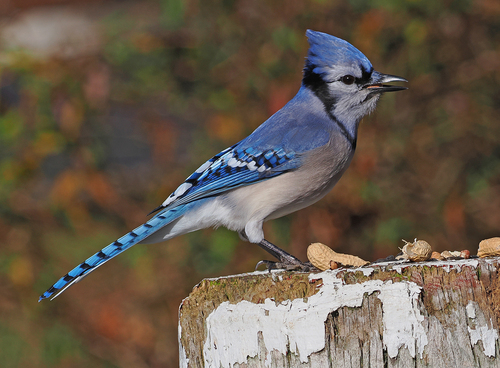
Blue Jay
Cyanocitta cristata
Conservation Status
Least ConcernAves · Passeriformes · Corvidae
About
The blue jay is a passerine bird in the family Corvidae, native to eastern North America. It lives in most of the eastern and central United States; some eastern populations may be migratory. Resident populations are also in Newfoundland, Canada; breeding populations are found across southern Canada. It breeds in both deciduous and coniferous forests, and is common in residential areas. Its coloration is predominantly blue, with a white chest and underparts, and a blue crest; it has a black, U-shaped collar around its neck and a black border behind the crest. Males and females are similar in size and plumage, which does not vary throughout the year. Four subspecies have been recognized.
Fun Fact
Blue jays aren't actually blue — their feathers contain no blue pigment. The color is produced by light scattering through tiny air pockets in the feather structure; crush a feather and the blue vanishes.
Quick Facts
Habitat
Deciduous and mixed forests
Diet
Omnivore
Lifespan
7-10 years
Threats
- Habitat Fragmentation
- Deforestation