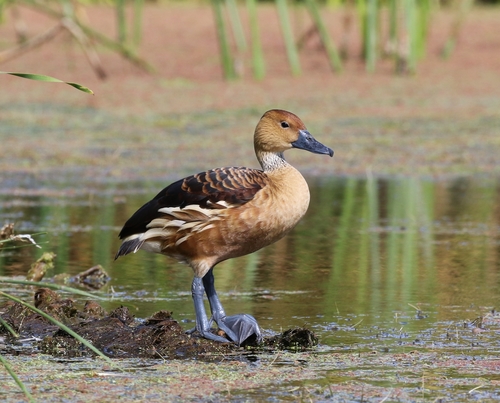
Fulvous Whistling-Duck
Dendrocygna bicolor
Conservation Status
Least ConcernAves · Anseriformes · Anatidae
About
The fulvous whistling duck or fulvous tree duck is a species of whistling duck that breeds across the world's tropical regions in much of Mexico and South America, the West Indies, the southern United States, sub-Saharan Africa and the Indian subcontinent. It has plumage that is mainly reddish brown, long legs and a long grey bill, and shows a distinctive white band across its black tail in flight. Like other members of its ancient lineage, it has a whistling call which is given in flight or on the ground. Its preferred habitat consists of wetlands with plentiful vegetation, including shallow lakes and paddy fields. The nest, built from plant material and unlined, is placed among dense vegetation or in a tree hole. The typical clutch is around ten whitish eggs. The breeding adults, which pair for life, take turns to incubate, and the eggs hatch in 24–29 days. The downy grey ducklings leave the nest within a day or so of hatching, but the parents continue to protect them until they fledge around nine weeks later.
Fun Fact
It is not normally a mountain species, breeding in Venezuela, for example, only up 300 m (980 ft), but the single Peruvian breeding record was at 4,080 m (13,390 ft).
Quick Facts
Habitat
Found in lowland marshes and swamps in open, rice fields, flat country, and it avoids wooded areas.
Diet
Eat a few insects.
Lifespan
To be updated
Threats
- Habitat Change
- Human Disturbance