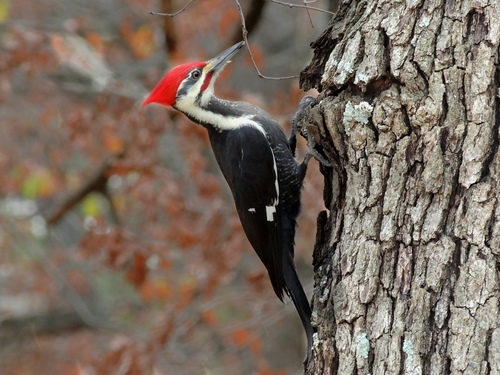
Pileated Woodpecker
Dryocopus pileatus
Conservation Status
Least ConcernAves · Piciformes · Picidae
About
The pileated woodpecker is a large, crow-sized woodpecker with a prominent red crest, white neck stripe, and a mostly black body. This woodpecker is native to North America, where it is the largest confirmed extant woodpecker species and the third-largest extant species of woodpecker in the world, after the great slaty woodpecker and the black woodpecker. It inhabits deciduous forests in eastern North America, the Great Lakes, the boreal forests of Canada, and parts of the Pacific Coast. This woodpecker is primarily an insectivore, eating insects that live in trees; it is famous for making large, nearly rectangular carvings into trees, which are used to extract prey inside the tree or to make a nest. The species has a large range and an increasing population, causing it to be categorized as a species of "least concern" by the IUCN in 2016.
Fun Fact
Pileated woodpeckers excavate rectangular holes in dead trees that are so large they can cause small trees to break in half, and their abandoned cavities become crucial nesting sites for owls, ducks, and bats.
Quick Facts
Habitat
Mature deciduous and coniferous forests
Diet
Insectivore
Lifespan
8-12 years
Threats
- Wildfire
- Deforestation