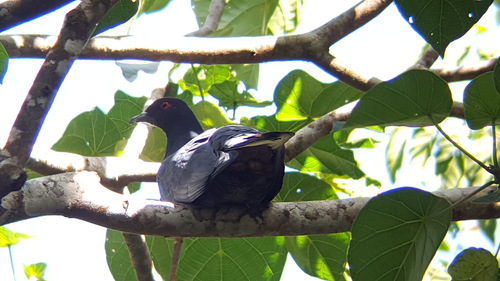
Black Imperial Pigeon
Ducula melanochroa
Conservation Status
Least ConcernAves · Columbiformes · Columbidae
About
The black imperial pigeon, also known as the Bismarck imperial pigeon, is a species of bird in the pigeon family, Columbidae. First described by English zoologist Philip Sclater in 1878, it is endemic to the Bismarck Archipelago, where it mainly inhabits rainforest and cloud forest in mountain areas above 500 m (1,600 ft). It is a large, heavily built imperial pigeon, with a length of 38–43 cm (15–17 in) and a weight of 661–665 g (23.3–23.5 oz). Adults are almost entirely black, except for the dark chestnut undertail coverts, the silvery-grey underside of the tail, and a pale grey scaly pattern on the wings and back. Both sexes look alike. Juveniles differ from adults in having paler undertail coverts.
Fun Fact
The species feeds on fruit in the canopy, usually alone or in small flocks of up to 20 birds, though flocks of up to 40 birds have been found on fig trees.
Quick Facts
Habitat
Endemic to the Bismarck Archipelago, where it is found on the islands of Umboi, New Britain, Watom, Duke of York, and New Ireland.
Diet
Feeds on fruit in the canopy, usually alone or in small flocks of up to 20 birds, though flocks of up to 40 birds have been found on fig trees.
Lifespan
To be updated
Threats
- Habitat Change
- Human Disturbance