Blue-faced Honeyeater
Entomyzon cyanotis
Conservation Status
Least ConcernAves · Passeriformes · Meliphagidae
About
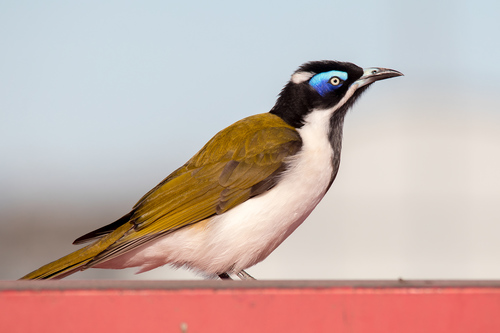
The blue-faced honeyeater, also colloquially known as the bananabird, is a passerine bird of the honeyeater family, Meliphagidae. It is the only member of its genus, and it is most closely related to honeyeaters of the genus Melithreptus. Three subspecies are recognised. At around 29.5 cm (11.6 in) in length, the blue-faced species is large for a honeyeater. Its plumage is distinctive, with olive upperparts, white underparts, and a black head and throat with white nape and cheeks. Males and females are similar in external appearance. Adults have a blue area of bare skin on each side of the face readily distinguishing them from juveniles, which have yellow or green patches of bare skin.
Fun Fact
The record for longevity was a bird banded in May 1990 in Kingaroy in central Queensland, which was found dead on a road after 8 years and 3.
Quick Facts
Habitat
Occurring in the Northern Rivers and Northern Tablelands regions, and along the coast south to Nambucca Heads.
Diet
Prey are caught mostly by sallying, although birds also probe and glean.
Lifespan
8 years
Threats
- Habitat Change
- Human Disturbance