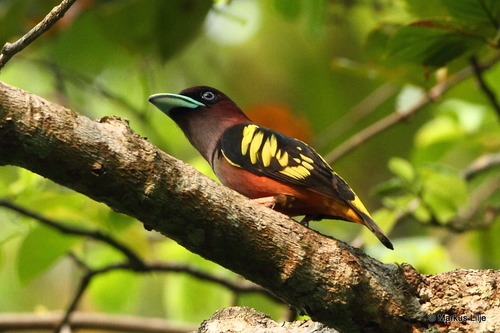
Banded Broadbill
Eurylaimus javanicus
Conservation Status
Least ConcernAves · Passeriformes · Eurylaimidae
About
The banded broadbill is a species of bird in the typical broadbill family Eurylaimidae found in Mainland Southeast Asia and the Greater Sunda Islands. It is sometimes split into two species, one including only the nominate subspecies, E. j. javanicus, and one including all the remaining subspecies. It inhabits a variety of forests, along with forest edge, rubber plantations and Falcataria falcata groves, mainly in lowland areas. A striking, large-bodied bird with a length of 21.5–23.0 cm (8.5–9.1 in), it is unlikely to be mistaken for another species. The broadbill is mostly purplish-red, with yellow-streaked black wings, a bright blue beak, a blackish face and greyish chin and upper breast. Females can be told apart from males by their lack of a black neckband, although these are indistinct in Bornean and Javan males. Despite its conspicuous appearance, the bird is usually hard to see due to its sluggishness and is usually only noticed when it vocalises.
Fun Fact
The species' song is a remarkable, short, loud wheeoo or wiuk, occasionally prefaced with 4–9 whirr notes and always followed with a noisy, high-speed, rattling trill lasting 5–9 seconds that initially rises in pitch before quickly falling.
Quick Facts
Habitat
Inhabits several types of forest, including primary forests, selectively logged forests that have regrown, peat swamp forests, high-altitude heath forests, freshwater swamp forests, forest edge, rubber plantations and Falcataria falcata groves.
Diet
Feeds on true bugs (Hemiptera), snails, spiders and beetles such as ground beetles (Carabidae), darkling beetles (Tenebrionidae) and true weevils (Curculionidae).
Lifespan
To be updated
Threats
- Habitat Change
- Human Disturbance