ʻAkiapolaʻau
Hemignathus wilsoni
Conservation Status
EndangeredAves · Passeriformes · Fringillidae
About
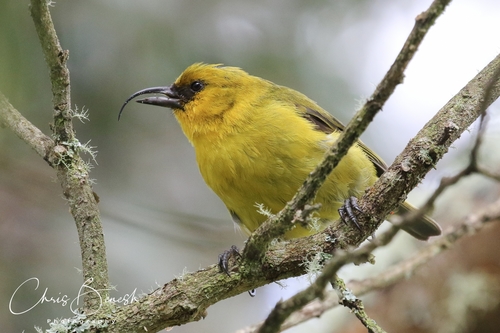
The ʻakiapōlāʻau, pronounced ah-kee-ah-POH-LAH-OW, is a species of Hawaiian honeycreeper that is endemic to the island of Hawaii. Its natural habitats are dry and montane moist forests, and it is the only bird species on the island to occupy the woodpecker niche. The bird is 5.5 inches (14 cm) in length, and has an unusually curved beak-(a specialist species). The ʻakiapolaʻau is a pudgy bird which has a whitish bottom and tail, black legs, yellow chest, orangish head, black face mask and bill and gray black wings. The male's song is either a loud, short pit-er-ieu or a rapid warba-warba. Its various calls include an upslurred whistle, a short cheedle-ee warble, and a short sweet. Due to the recent disappearance of the Kauai nukupuʻu in the 1900s and the Maui nukupuʻu in the 1990s, leading to fears that they may be extinct, the ʻakiapōlāʻau may be the last of its genus. It is the only member of the subgenus Heterorhynchus, which has a woodpecker-like feeding habitat and exclusively preys on insects, in contrast to the nukupuʻu, which were both insect-eaters and also hummingbird-like nectarivores.
Fun Fact
It is the only member of the subgenus Heterorhynchus, which has a woodpecker-like feeding habitat and exclusively preys on insects, in contrast to the nukupuʻu, which were both insect-eaters and also hummingbird-like nectarivores.
Quick Facts
Habitat
Occurs mainly in old-growth mesic and wet forests in Kaʻū, Hilo District, and Hamakua.
Diet
Feeds on insects which are found hidden within the branches of the trees, along with the nectar of flowers shaped like its bill.
Lifespan
To be updated
Threats
- Habitat Loss
- Poaching and Hunting
- Human-Wildlife Conflict
- Disease