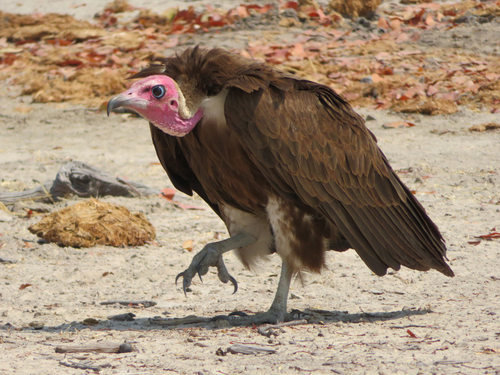
Hooded Vulture
Necrosyrtes monachus
Conservation Status
Critically EndangeredAves · Accipitriformes · Accipitridae
About
The hooded vulture is an Old World vulture in the order Accipitriformes, which also includes eagles, kites, buzzards and hawks. It is the only member of the genus Necrosyrtes, which is sister to the larger Gyps genus, both of which are a part of the Aegypiinae subfamily of Old World vultures. It is native to sub-Saharan Africa, where it has a widespread distribution with populations in southern, East and West Africa. It is a scruffy-looking, small vulture with dark brown plumage, a long thin bill, bare crown, face and fore-neck, and a downy nape and hind-neck. Its face is usually a light red colour. It typically scavenges on carcasses of wildlife and domestic animals. Although it remains a common species with a stable population in the lower region of Casamance, some areas of The Gambia, and Guinea-Bissau, other regions such as Dakar, Senegal, show more than 85% losses in population over the last 50 years. Threats include poisoning, hunting, loss of habitat and collisions with electricity infrastructure, and the International Union for Conservation of Nature has rated its conservation status as "critically endangered" in their latest assessment (2022). The highest current regional density of hooded vultures is in the western region of The Gambia.
Fun Fact
It occurs up to 4,000 m, but is most numerous below 1,800 m.
Quick Facts
Habitat
Restricted to the Kruger National Park and surrounding protected areas in Mpumalanga and Limpopo provinces, though vagrants have been recorded further west in Kwa-Zulu Natal and Kgalagadi Transfrontier Park.
Diet
Feeds on carrion; "syrtes" which means "cord" and "monachus" which is Latin for "monk" and relates to the hood of the vulture.
Lifespan
To be updated
Threats
- Habitat Destruction
- Pollution
- Invasive Species
- Over-Collection
- Climate Change