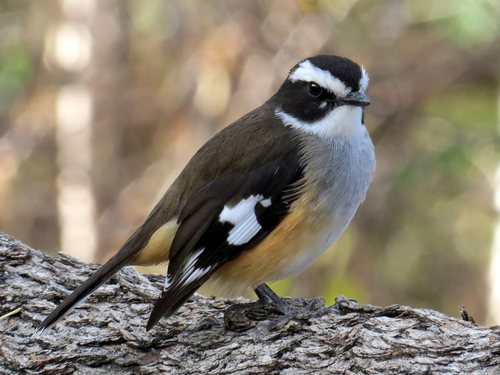
Buff-sided Robin
Poecilodryas cerviniventris
Conservation Status
Least ConcernAves · Passeriformes · Petroicidae
About
The buff-sided robin is a small, diurnal, insectivorous, perching (passerine) bird in the family Petroicidae, a group commonly known as the Australo-Papuan or Australasian robins. It is also known as the buff-sided fly-robin, buff-sided shrike-robin, and Isabellflankenschnäpper (German). The buff-sided robin is endemic to northern Australia, where it primarily occurs in riparian forests and monsoon vine thickets from the Kimberly region of Western Australia to the north-west Queensland Gulf of Carpentaria. The plumage of the adult birds is characterized by a dark hood and back with a prominent white stripe on the supercilium; a white throat, white wing and tail bars, and a striking buff to orange patch on the flank below the wings. Adult birds are not sexually dimorphic; however, males are generally larger and can be separated from females based on morphological measurements. Buff-sided robins predominantly take insects from the ground by sallying from an observational perch. Insects are also occasionally taken by hawking on the wing or by gleaning from the trunk or foliage of riparian vegetation.
Fun Fact
The buff-sided robin was described as a unique species by the ornithologist and naturalist John Gould in 1857.
Quick Facts
Habitat
Occurs in suitable habitat within northern coastal drainage basins from the Kimberley region of north-west Western Australia, the Top End of the Northern Territory to the north-western Gulf of Carpentaria in Queensland.
Diet
Insectivore
Lifespan
9 years
Threats
- Habitat Change
- Human Disturbance