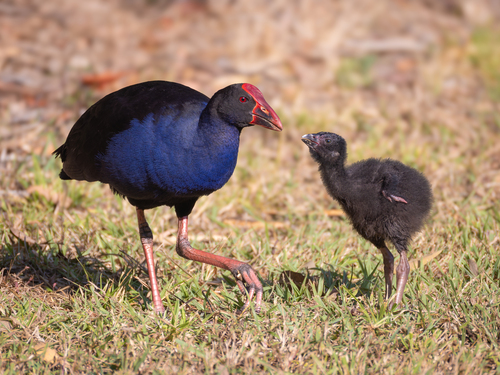
Australasian Swamphen
Porphyrio melanotus
Conservation Status
Data DeficientAves · Gruiformes · Rallidae
About
The Australasian swamphen, commonly known as the pūkeko in New Zealand, is a striking and socially complex bird found in Oceania, including eastern Indonesia, Papua New Guinea, New Zealand and Australia. A member of the rail family, it is part of the diverse order Gruiformes, which includes species with similar characteristics such as cranes and other rail species. Within the Australasian swamphen species, five recognised subspecies exist, with P. m. melanotus being the most common and widely distributed in New Zealand. They display phenotypic characteristics typical of rails: relatively short wings and strong, elongated bills, adapted to its semi-aquatic lifestyle in wetlands.
Fun Fact
Australasian Swamphens have colonized New Zealand from Australia in the last 1,000 years entirely under their own power—one of the most recent natural colonizations documented.
Quick Facts
Habitat
Found in low-lying wetlands with vegetation like flax, raupo, and rushes, the swamphen is also common in estuaries, salt marshes, and along riverbanks.
Diet
Consume plant material, including stems, shoots, leaves, and seeds of various grasses, sedges, rushes, and clover.
Lifespan
To be updated
Threats
- Habitat Change
- Human Disturbance