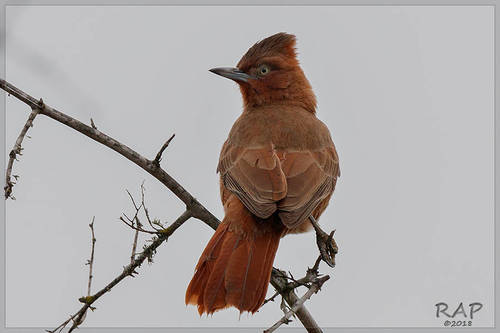
Brown Cacholote
Pseudoseisura lophotes
Conservation Status
Least ConcernAves · Passeriformes · Furnariidae
About
The brown cacholote is a medium-sized bird of the ovenbird family Furnariidae. It was described by Ludwig Reichenbach in 1853, with its subspecies, argentina, described in 1960 by Kenneth Carroll Parkes. It is nonmigratory, and is found in the forests and parks of Argentina, Bolivia, Brazil, Paraguay, and Uruguay. Unlike many other birds, the brown cacholote builds large, pitcher-like nests year-round, each weighing many times more than the bird itself. Breeding begins in mid-November, with both parents sharing the responsibility for taking care of the nest equally. Incubation takes 17–20 days, and nestlings fledge at 19 days. They are omnivorous, primarily eating various arthropods, along with the eggs of other birds, fruits, and grain. The causes of death in adults is not well researched; however, nestlings are subject to parasitism from various insects. Egg success rate is 59%. They are a least-concern species.
Fun Fact
oz), making it one of the largest furnariids.
Quick Facts
Habitat
To be updated
Diet
Diet include tree sap, various seeds, snails, various small amphibians, and fruit.
Lifespan
To be updated
Threats
- Habitat Change
- Human Disturbance