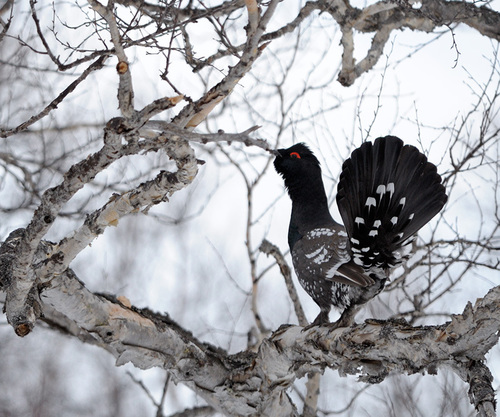
Black-billed Capercaillie
Tetrao urogalloides
Conservation Status
Least ConcernAves · Galliformes · Phasianidae
About
The black-billed capercaillie is a large grouse species closely related to the more widespread western capercaillie. It is a sedentary species that breeds in the larch taiga forests of eastern Siberia as well as parts of northern Mongolia and China. In the far west of its distribution, the black-billed capercaillie has been known to hybridize with the western capercaillie. Compared to its western cousin, the black-billed capercaillie is also more adaptable to open habitat, given the larch forests it lives in are usually less dense than other taiga communities. Thus, they tend to avoid thick coniferous forests. They are primarily herbivorous, feeding on twigs, buds, leaves, shoots, and berries of various plants. However, their diet in the warmer months includes some insects like caterpillars, larvae, ants and midges.
Fun Fact
This creates a unique forest of "dwarf larches," often referred to as a "garden" or "park forest.
Quick Facts
Habitat
Lives in are usually less dense than other taiga communities.
Diet
Feeds on twigs, shoots, and buds from various plant species, as well as the fruit of Rosa acicularis (commonly known as the prickly wild rose).
Lifespan
To be updated
Threats
- Habitat Change
- Human Disturbance