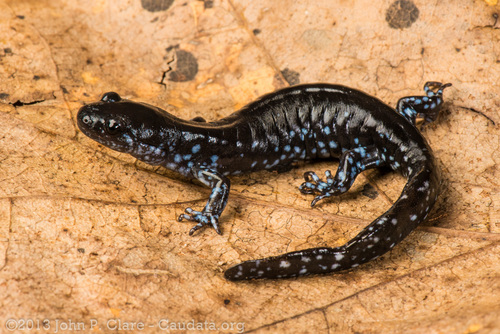
Blue-spotted Salamander
Ambystoma laterale
Conservation Status
Least ConcernAmphibia · Caudata · Ambystomatidae
About
The blue-spotted salamander is a mole salamander native to the Great Lakes states and northeastern United States, and parts of Ontario and Quebec in Canada. Their range is known to extend to James Bay to the north, and southeastern Manitoba to the west.
Fun Fact
Clutches average a dozen eggs, and females may lay up to 500 eggs yearly.
Quick Facts
Habitat
Found in moist, deciduous hardwood forests and swampy woodlands with sandy soil, though they can be found in coniferous forests and fields too.
Diet
Eating invertebrates such as worms, snails, slugs, centipedes, and spiders, as well as insects.
Lifespan
To be updated
Threats
- Habitat Change
- Human Disturbance
External Data Sources
More Amphibians Species
Apennine Yellow-bellied Toad EN
Axolotl CR
Beddome's Leaping Frog EN
Bigfoot Chiropterotriton EN
Black-backed Salamander EN
Chinese Giant Salamander CR
Browse all Amphibians →