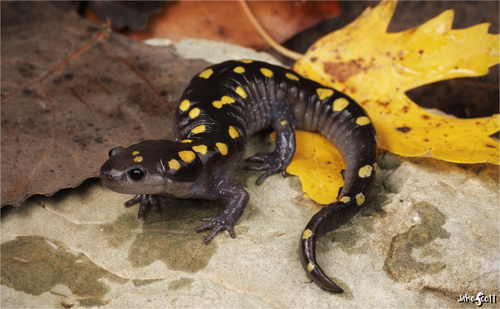
Spotted Salamander
Ambystoma maculatum
Conservation Status
Least ConcernAmphibia · Caudata · Ambystomatidae
About
The spotted salamander, also known commonly as the yellow-spotted salamander, is a species of mole salamander in the family Ambystomatidae. The species is native to the eastern United States and Canada. It is the state amphibian of Ohio and South Carolina. The species ranges from Nova Scotia, to Lake Superior, to southern Georgia and Texas. Its embryos have been found to have symbiotic algae, Chlorococcum amblystomatis, living in and around them, the only known example of vertebrate cells hosting an endosymbiont microbe.
Fun Fact
Spotted salamanders form a symbiosis with green algae that grows inside their eggs, providing oxygen directly to embryos — the only known vertebrate to host photosynthetic algae inside cells.
Quick Facts
Habitat
Lives in mature forests with ponds or ephemeral vernal pools for breeding sites.
Diet
Eats smaller salamanders, such as the red-backed salamander.
Lifespan
20 years
Threats
- Habitat Change
- Human Disturbance