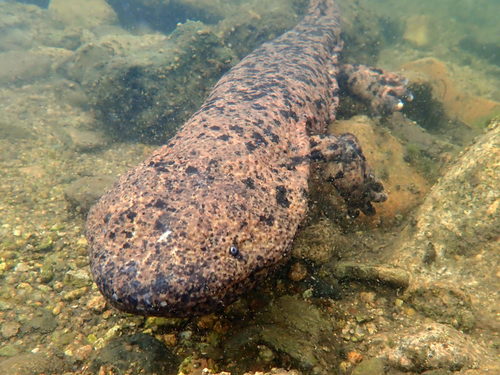
Japanese Giant Salamander
Andrias japonicus
Conservation Status
Near ThreatenedAmphibia · Caudata · Cryptobranchidae
About
The Japanese giant salamander is a species of fully aquatic giant salamander endemic to Japan, occurring across the western portion of the main island of Honshu, with smaller populations present on Shikoku and in northern Kyushu. With a length of up to 5 feet (1.5 m), it is the third-largest salamander in the world, being surpassed only by the very similar and closely related Chinese giant salamander and the South China giant salamander.
Fun Fact
The Japanese giant salamander can reach nearly 5 feet in length and uses lateral line sensors similar to fish to detect vibrations in the water without seeing.
Quick Facts
Habitat
Found in fast-flowing mountain streams of these prefectures.
Diet
Feed mainly on freshwater crabs, other crustaceans, worms, insects, frogs, other small amphibians, fish, and even small mammals.
Lifespan
52 years (captivity)
Threats
- Habitat Change
- Human Disturbance