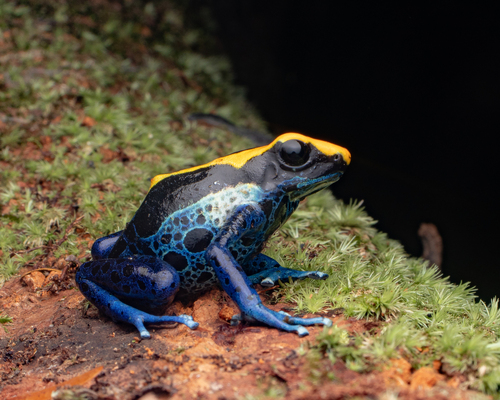
Dyeing Poison Dart Frog
Dendrobates tinctorius
Conservation Status
Least ConcernAmphibia · Anura · Dendrobatidae
About
The dyeing poison dart frog, also known as the cobalt poison frog, tinc, is a species of poison dart frog. It is among the most variably colored and largest species of poison dart frogs, typically reaching snout–vent lengths of about 50 mm (2.0 in). It is distributed in the eastern portion of the Guiana Shield, including parts of French Guiana, Guyana, Suriname, and Brazil. These types of frogs usually like to stay in the ground as it is easier to catch prey. They tend to also stay in bodies of water like rivers or climb trees. Because of this they mostly inhabit near the Amazon rainforest. To mate they have special rituals and leave their tadpoles in freshwater.
Fun Fact
Indigenous Amerindians used the skin secretions of the dyeing poison dart frog to dye the feathers of green parrots to exotic yellow and red colors — a practice called 'tapirage'.
Quick Facts
Habitat
Found in regions of tropical primary rainforests, but is associated with areas with canopy gaps.
Diet
Diet of chemical-containing arthropods, largely ants and mites .
Lifespan
To be updated
Threats
- Habitat Change
- Human Disturbance