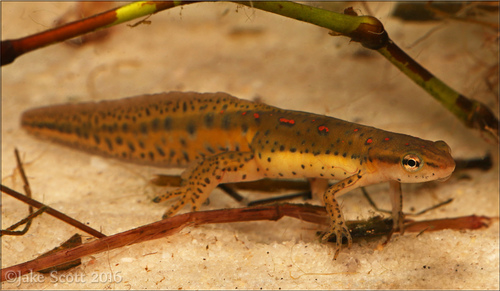
Eastern Newt
Notophthalmus viridescens
Conservation Status
Least ConcernAmphibia · Caudata · Salamandridae
About
The eastern newt is a common newt of eastern North America. It frequents small lakes, ponds, and streams or nearby wet forests. The eastern newt produces tetrodotoxin, which makes the species unpalatable to predatory fish and crayfish. It has a lifespan of 12 to 15 years in the wild, and it may grow to 5 in (13 cm) in length. These animals are common aquarium pets, being either collected from the wild or sold commercially. The striking bright orange juvenile stage, which is land-dwelling, is known as a red eft. Some sources blend the general name of the species and that of the red-spotted newt subspecies into the eastern red-spotted newt.
Fun Fact
Eastern newts have a unique three-stage life cycle: aquatic larva, then a bright-red terrestrial eft that wanders for years, then returns to water as a dull-green adult.
Quick Facts
Habitat
Habitat preferences include shallow water, quiet stretches of streams, swamps or ditches, lakes and ponds with heavy submerged vegetation.
Diet
Feed on small aquatic invertebrates, and as adults, they eat insects, worms, snails, and other small invertebrates.
Lifespan
15 years (wild)
Threats
- Habitat Change
- Human Disturbance