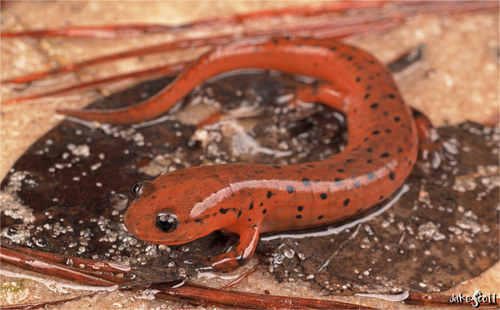
Mud Salamander
Pseudotriton montanus
Conservation Status
Least ConcernAmphibia · Caudata · Plethodontidae
About
The mud salamander is a bright red salamander of the family Plethodontidae. It is found in streams, seeps and swamps and underneath logs, rocks and leaves. It is endemic to the eastern half of the United States with one isolated population in central Mississippi. Mud salamanders are rarely seen plethodontids that inhabit muddy wetland and riparian habitats. Mud salamanders don't generally live above 700 meters in elevation in the Appalachian Mountains, resulting in two geographically isolated populations. Mud salamanders have short stocky bodies ranging from 7.5 to 16 cm long. Body color ranges with age and locality. There are four subspecies in the mud salamander complex, namely the Gulf Coast mud salamander, rusty mud salamander, Midland mud salamander and the eastern mud salamander. Mud salamanders are ectothermic, meaning that they cannot control their body temperature and it fluctuates with the temperature. The mud salamander is readily confused with two other species, the red salamander and the spring salamander.
Fun Fact
The mud salamander produces a proteinaceous skin toxin along the backside of its body that can induce symptoms such as extreme irritability, hypothermia, and physical weakness in their predators.
Quick Facts
Habitat
Inhabits swamps in low elevations, bogs, seeps, springs, and streams that not only provide a muddy bottom, but also clean and clear water.
Diet
Feed on equal-sized or smaller, aquatic invertebrates.
Lifespan
To be updated
Threats
- Habitat Change
- Human Disturbance