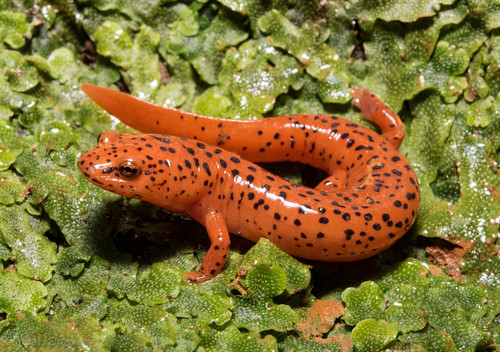
Red Salamander
Pseudotriton ruber
Conservation Status
Least ConcernAmphibia · Caudata · Plethodontidae
About
The red salamander is a species of salamander in the family Plethodontidae endemic to the Eastern United States. Its skin is brown, orange or red with random black spots. Semiaquatic adults and aquatic larvae live in temperate forests, small creeks, bogs, ponds, intermittent streams, and freshwater springs. Overall this species is common and widespread, but locally it has declined because of habitat loss and it is considered threatened in Indiana and New York. Red salamanders eat insects, earthworms, spiders, small crustaceans, snails, and smaller salamanders. To eat, they extend their tongue to capture prey on the tip of it and retract it back into their mouths. The red salamander, as a member of the family Plethodontidae lacks lungs and respires through its skin.
Fun Fact
The Blue Ridge red salamander is found in elevations to more than 5,000 ft (1,500 m) in the southern part of the Blue Ridge Mountains of Virginia.
Quick Facts
Habitat
Found across the eastern United States, occupying streams through open areas such as fields and meadows and deciduous or mixed hardwood forests, especially near streams, seepages, and damp settings.
Diet
Eat insects, earthworms, spiders, small crustaceans, snails, and smaller salamanders.
Lifespan
To be updated
Threats
- Habitat Change
- Human Disturbance